

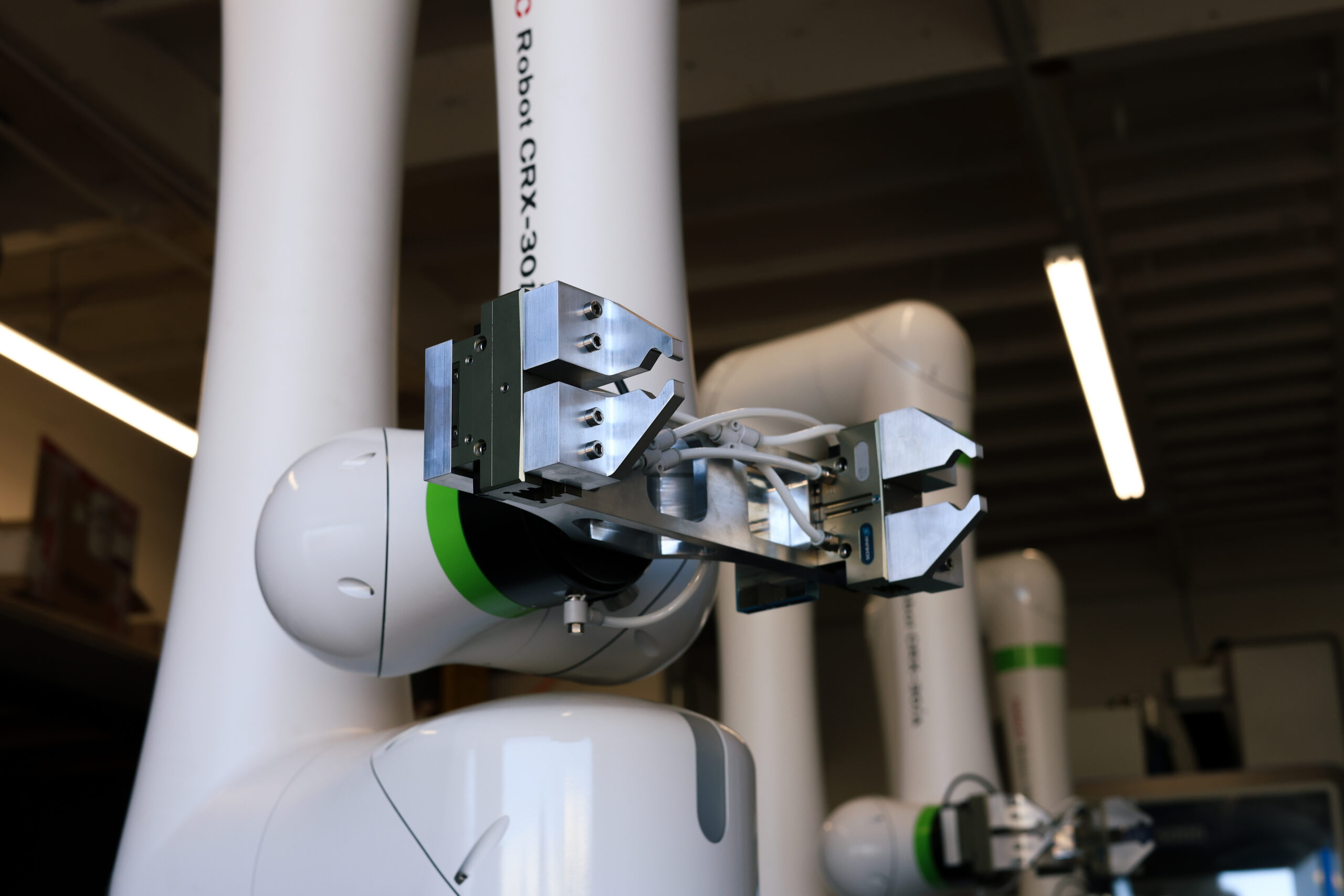
AI vision systems are advancing. But as capabilities expand and new applications emerge across industries like aerospace, technological advancement alone doesn’t improve outcomes in CNC automation.
What matters is whether an AI vision system is engineered for your precise application.
Especially in high-mix, low-volume facilities, the difference between a system that demos well and one that performs reliably is significant. Because in these environments, consistency matters far more than novelty.
That distinction shapes how we think about AI vision systems for CNC automation at SDMS Robotics.
- AI vision systems must be built for CNC machine tending
- Your systems should be aligned around precision, not novelty
- Our philosophy: If doesn’t require AI, don’t use it
How do you build AI vision systems for CNC automation?
Trying to do everything should not be the goal
CNC automation performs specific jobs: identifying parts, orienting them correctly, loading and unloading them with precision.
Traditional AI vision systems are often designed to expand what the system can interpret. But that’s the wrong objective. The goal shouldn’t be to interpret everything. It should be to execute a defined task correctly, every time. Without time-consuming programming and reprogramming for each component.
We’re developing our own AI vision systems with that discipline in mind.
If integration isn’t specific, you have the wrong system
Existing CNC infrastructure relies on narrow operation parameters, which leaves little room for ambiguity.
Generalized vision systems, however, try to manage every possible scenario. This prevents them from integrating well with your highly specified current infrastructure. And when integration isn’t specific, operators end up compensating for the system, slowing the cycle.
We develop our systems to integrate directly with existing industrial PC, PLC and automation cell architectures. It should use the same methodologies that have already been established.
The objective is straightforward: make CNC tending more adaptable without introducing complexity. This includes retaining well-established safety and operations tech that FANUC robots have refined over decades, as well as minimizing the number of “black boxes” added into systems to keep maintenance simple.
Align AI vision systems around precision, not novelty
AI is powerful — it must be applied with discernment.
Machine learning always introduces a level of interpretation, and automated interpretation should not extend to every decision in CNC machining. When a misidentified or misloaded part can cost tens of thousands of dollars, AI must only support precision, not replace it.
Our philosophy: If a problem doesn’t require AI, don’t use it
This principle has been guiding the development of our AI vision systems from the very beginning. If a feature is unnecessary, we won’t add it to the system. Just as importantly, we design systems that fit into existing operations, not imaginary ones.
In practice, disruption shows up when a vision system changes how work already gets done. Operators will have to adjust setups to help the system recognize parts, and engineers will lose time tuning scenarios the operation never needed before.
When the system is designed around CNC workflows, the opposite happens — the workflow remains familiar, and the technology enhances the operation rather than redefines it.
Our philosophy keeps the focus where it belongs: easy integration and systems your decision-makers can understand. That’s how AI vision becomes useful in CNC automation.
Let’s talk about your operations
Whether you’re interested in integrating CNC automation or you’re curious about AI vision systems, get in touch with our team. We’ll get back to you within a business day.